
Transformative Colour-Resonance Environments (TCRE)
RMIT Course Design | Affective Design Education | Practice-Based Research
#AffectiveDesign #DesignPsychology #ColourPsychology #AudioVisualDesign DesignByResearch #ProductionDesign #ExhibitionDesign #DigitalMediaCuration #CulturalHeritage #Innovation #ProjectManagement #3D #Gamification
Overview
TCRE is a pioneering 24-point course I designed from scratch as inaugural studio lead at RMIT University. It integrates affective design theory, colour psychology, sound design, interaction psychology and virtual exhibition curation, into a comprehensive research-led curriculum that pushes students to understand how audiovisual environments shape emotional and cognitive experience.
Students are inspired to research, prototype, and contextualize how light, colour, and sound create transformative experiences. Individual user-research pathways are integrated within broader fields of UX/interaction design as technical and creative resonance and colour theory and research.


TCRE challenges students to:
Understand colour and sound as spectrum languages for emotional communication
Apply empirical research methodologies to subjective aesthetic decisions
Design experiences that are both scientifically informed and creatively innovative
Document and contextualize their practice-based research as scholarly work
Course Structure & Pedagogy
Research-Led Design Methodology
Students develop individual research pathways exploring:
Colour psychology - How hue, saturation, brightness affect mood and cognition
Sonic resonance - Psychoacoustic principles and frequency-emotion relationships
Audiovisual integration - How sound and light interact to amplify affective impact
Cultural semiotics - Understanding how meaning varies across mediums and contexts
Phase 1: Research & Conceptualization
Literature review of colour theory, sound psychology, affective design
User research and comparative analysis studies
Development of research questions and hypotheses
Conceptual frameworks for audiovisual-colour resonance
Phase 2: Design & Planning
Translation of research into design specifications
Production planning and technical documentation
Iterative prototyping and user testing
Refinement based on empirical and qualitative feedback
Phase 3: Production & Execution
Creation of immersive audiovisual environments
Application of affective design principles to real-world outputs
Technical execution across multiple media (sound, light, interaction)
Documentation of process and decision-making
Phase 4: Contextualisation & Exhibition
Critical reflection on research and outcomes
Curation of work within 3D online immersive galleries (Spatial.io)
Professional presentation of both process and product
Exhibition design as final assessment of research communication


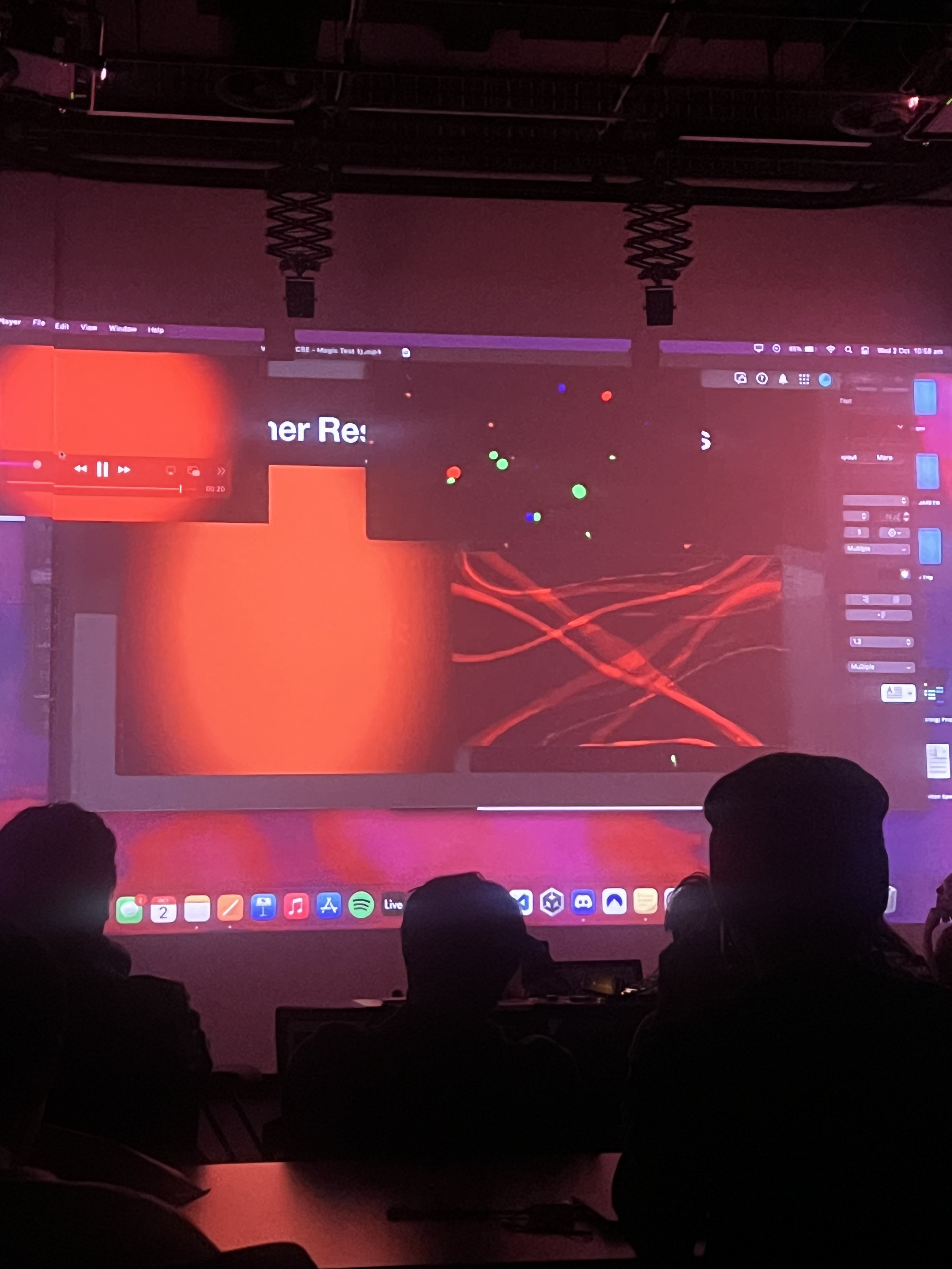


Innovative Assessment Design
Publicly Accessible Virtual Galleries
Rather than traditional portfolios, students curate their work in 3D navigable exhibition spaces that serve multiple purposes:
Exhibition of final work - Immersive presentation of audiovisual outcomes
Process documentation - Visual research journey displayed spatially
Skills demonstration - Shows technical mastery of 3D environment design
Professional portfolio piece - Shareable, impressive showcase for future opportunities
This exhibition design functions as both interactive-design-assessment & portfolio artefact—gives that provides designers with real-world value from their skills development that demonstrates the value of interactive practice-based research.
Technical Competencies
Advanced colour theory and application (HSL, RGB, HEX spectrum systems)
Psychoacoustic principles for affective sound design
3D environment design and spatial storytelling
Research documentation and academic writing
Exhibition curation and presentation design
Conceptual Development
Understanding affective design as research discipline
Applying behavioural psychology to creative practice
Systems thinking for experiential design
Critical analysis of cultural and contextual meaning
Ethical frameworks for persuasive design
Professional Practices
Practice-based research methodologies
Iterative design and user testing
Professional documentation and presentation
Cross-disciplinary communication
Portfolio development and self-promotion
Student Outcomes & Impact
Transformative Learning Experiences


Student testimonials highlight the course's profound impact:
"TCRE taught me transferable skills regarding colour, sound, and the interplay between them to shape environments/emotions. It definitely helped me develop my sensitivity to colour, sound and emotions and the incorporation of these attributes within design."
— TaiShang Sun, RMIT Alumni
"I learned practical and academic skills that have profoundly shaped my approach to design, including methods in colour psychology theories, semantic colour mapping, resonance analysis, and affective design principles and processes."
— Wunhao Li, 3D Artist / Game Designer
"After TCRE, I have a completely different understanding of colour as a medium of depth, not just surface value. Furthermore, I am now more confident in my knowledge and also feel more attuned to my surroundings."
— Nimuel Nghi Duong, Digital Designer
Career Scope & Advancement
TCRE graduates have gone on to roles in:
UX/UI design with emotional intelligence focus
Immersive experience design (museums, exhibitions, events)
Architectural lighting and environmental design (Physical and Virtual)
Digital wellbeing and therapeutic applications
Game design and interactive media
Industry & Academic Recognition
Course Innovation
First of its kind at RMIT to fully integrate affective design research into undergraduate curriculum
Interdisciplinary model combining psychology, design, technology, and creative practice
Assessment innovation using 3D virtual galleries as both exhibition and portfolio
Practice-based research focus preparing students for research-led industry roles
Key Insights & Pedagogical Innovation
Research as Creative Process
Students learn that rigorous research doesn't constrain creativity—it deepens it. Understanding the "why" behind color and sound choices makes design more intentional and impactful.
Process as Product
The emphasis on documenting and exhibiting research processes teaches students that design thinking itself is valuable, not just final outputs.
Affective Design as Core Competency
Rather than treating emotion as subjective or secondary, TCRE positions affective awareness as a professional skill that can be learned, practiced, and refined.
Digital Exhibition Literacy
Students gain experience with spatial design, virtual curation, and immersive storytelling—skills increasingly valuable in XR, gaming, and digital experience industries.


Deliverables & Student Work Examples
Student projects have explored:
Circadian rhythm regulation through adaptive lighting systems
Sonic environments for meditation and focus
Color-emotion mapping for therapeutic applications
Immersive installations exploring cultural color symbolism
Interactive audiovisual systems responding to user movement/biometrics
Key Takeaways
Both 12pt and 24-point courses designed from scratch as inaugural studio lead
Research-led pedagogy integrating psychology, design, and technology
Innovative assessment using 3D virtual gallery exhibitions
Transformative student outcomes with consistently exceptional feedback
Industry-relevant skills preparing graduates for emerging design roles
Pedagogical innovation influencing curriculum development across institution
TCRE demonstrates that affective design education can be both academically rigorous and creatively liberating—equipping students with the research skills and emotional intelligence to design meaningful experiences.